15 February 2026
Share


Long regarded as the pinnacle of Fujian cuisine, Buddha Jumps Over the Wall takes center stage at Lunar New Year reunion feasts. Bringing together prized delicacies from land and sea in a single pot, it is not only a beloved festive dish but also a powerful symbol of abundance, celebration and completeness. As Chinese culinary traditions have spread around the world, the dish has found its way onto global dining tables, where chefs continue to reinterpret it in ways that extend well beyond its traditional framework.
From imperial banquets to the family table
Buddha Jumps Over the Wall traces its origins to the Guangxu era of the Qing dynasty. According to legend, Zhou Lian, the Fujian provincial governor, once tasted a dish known as fushou quan — meaning happiness and longevity — a lavish stew prepared by the household chef of a government official and composed of more than a dozen prized ingredients. Deeply impressed, Zhou ordered his own kitchen master, Zheng Chunfa, to refine the dish further.
Zheng layered chicken, duck, abalone, sea cucumber and other delicacies into a Shaoxing wine jar and simmered them slowly over gentle heat. When the lid was finally lifted and the aroma escaped, scholars and gourmands are said to have exclaimed that even Buddha himself would abandon meditation and leap over the wall for a taste. From this moment, the dish earned its evocative name.
As culinary techniques spread beyond official kitchens, Buddha Jumps Over the Wall gradually made its way onto the home table. A jar filled with treasured ingredients came to symbolize prosperity and reunion, while its nourishing qualities and labor-intensive preparation meant it was most often reserved for year-end celebrations and family gatherings.
Over time, regional interpretations emerged, each with its own character. In Fujian, the dish is built on a chicken and duck stock, producing a glossy, amber-brown broth. Cantonese versions center on abalone sauce, valued for its depth and intensity. Taiwanese renditions emphasize frying — ingredients such as taro, crispy pork ribs and quail eggs are pre-fried to better absorb the broth, resulting in a rich, velvety texture. Meanwhile, at Bib Gourmand–recognized Jiang Nan in New York, the dish is reimagined with the restaurant’s signature golden soup, paired with sea cucumber, abalone and fish maw, creating a distinctive golden-broth expression of this classic.
RELATED: 15 Iconic Dishes to Celebrate the Year of the Horse — and Where to Eat Them
Innovative interpretations from MICHELIN restaurants
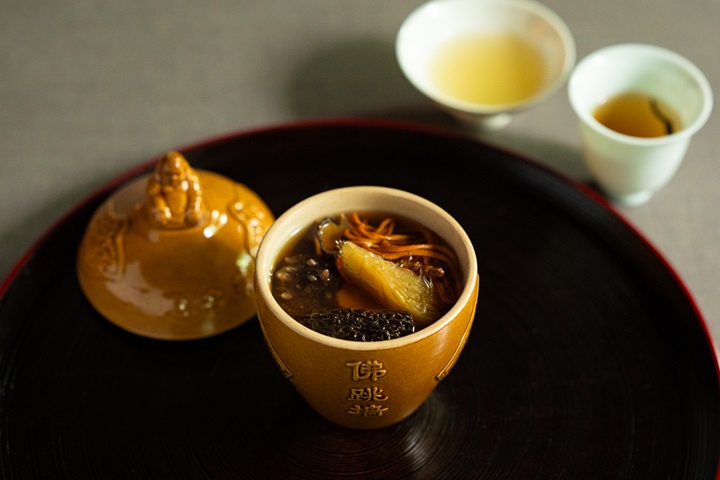
Three-MICHELIN-Starred Sazenka in Tokyo
Chef Tomoya Kawada, who spent two years living in Taiwan, devoted that time to tasting and studying various interpretations of Buddha Jumps Over the Wall. “Even then, I hoped to bring these experiences and impressions back to Japan and reinterpret the dish in a unique way,” he recalls.
In its second year of operation, Buddha Jumps Over the Wall officially joined Sazenka’s menu. Building on the traditional dish, Kawada draws on his extensive experience in both Japanese and Chinese cuisine to embody the spirit of wakon kansai — harmonizing the essence of both culinary worlds. He explains, “Each ingredient is prepared according to its nature — grilled, steamed or blanched — before being simmered together for about four hours. Everything is cut into bite-sized pieces, respecting the kaiseki concept of takiawase — cooking ingredients separately, then serving them together — while ensuring every bite delivers the true flavor of each component.” The resulting broth is amber-clear, delicate, balanced and refined.
The ingredients are bold and luxurious: alongside Japanese specialties like venison shank and bear meat, the dish features wild boar, soft-shelled turtle, cordyceps, crocodile, deer antler and more than twenty other rare delicacies. “The biggest challenge,” he notes, “is sourcing and preparing over twenty ingredients while keeping them fresh and consistent. Each item must be cooked with precise timing, technique and heat so that, in the end, all flavors harmonize into a single, delicious soup.” During a guest chef event in Taiwan in 2025, he drew further inspiration from local cuisine, adding snake meat to his version of the dish, and he is considering using sea snake (irabu) from traditional Okinawan cuisine in a future reinterpretation.
For Kawada, Buddha Jumps Over the Wall is more than a dish — it is a source of warmth. “When it’s cold, some guests feel under the weather, but after tasting the soup, they instantly feel invigorated,” he says. “I hope this dish can be more than just a soup — I want it to give people strength and comfort.”
Further Reading: Yama: Japan’s First Dessert-Only MICHELIN-Starred Restaurant
Two-MICHELIN-Starred 102 House in Shanghai
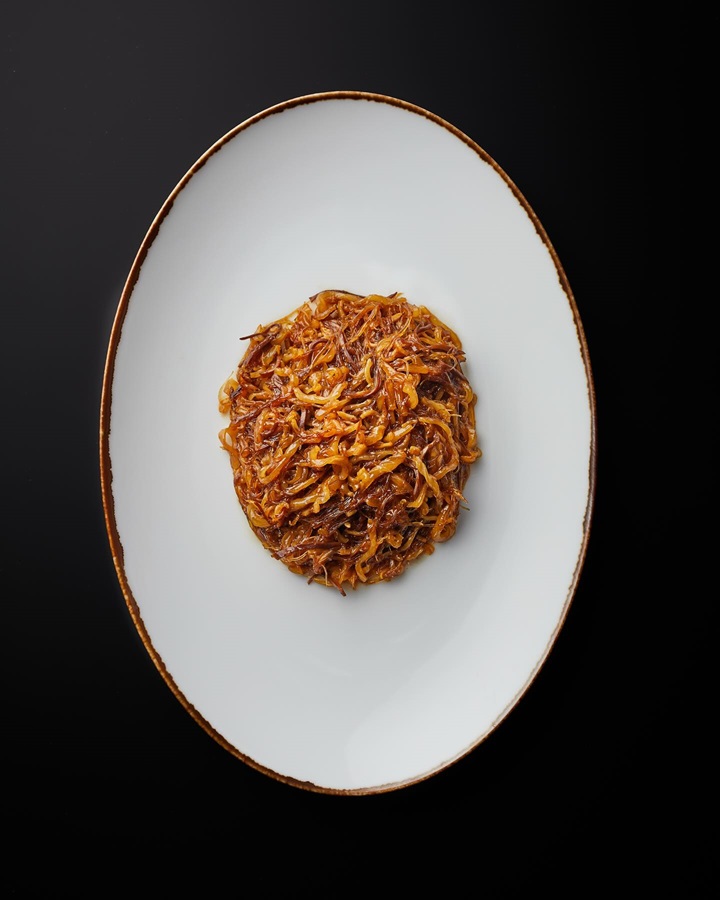
Renowned for its traditional Cantonese cuisine, 102 House has taken a bold approach to Buddha Jumps Over the Wall. Executive Chef Xu Jingye set out to challenge the conventional perception of the dish, creating a stir-fried version two to three years ago (Right Image ©102 House). He explains, “Traditionally, Buddha Jumps Over the Wall is served as a soup or braised dish. I wanted to reinterpret it using techniques that best represent Cantonese cuisine. Stir-frying not only captures the essence of Cantonese cooking, but compared with soups, it also brings out the dish’s aroma more vividly.”
The dish features premium dried ingredients, including top-grade abalone and African yellow fish maw, rehydrated and seasoned using traditional methods. Abalone and fish maw are sliced and quickly stir-fried with ham sauce to infuse flavor. To balance the richness of the dried ingredients and prevent heaviness, Xu adds dried Shunde mustard greens, which contribute to both a salty, fermented aroma and a crisp texture.
He notes that the greatest challenge in stir-frying lies in achieving the perfect moisture: the ideal result looks dry on the surface but remains tender and juicy inside. Because of the high heat, abalone sauce is added in three to four stages, ensuring the thick sauce fully penetrates every ingredient. Today, this stir-fried rendition has become a signature at 102 House, showcasing Xu’s innovative vision while giving a classic dish a fresh, contemporary interpretation.
RELATED: The Ultimate Secrets to Steamed Fish According to 2-Star 102 House in Shanghai
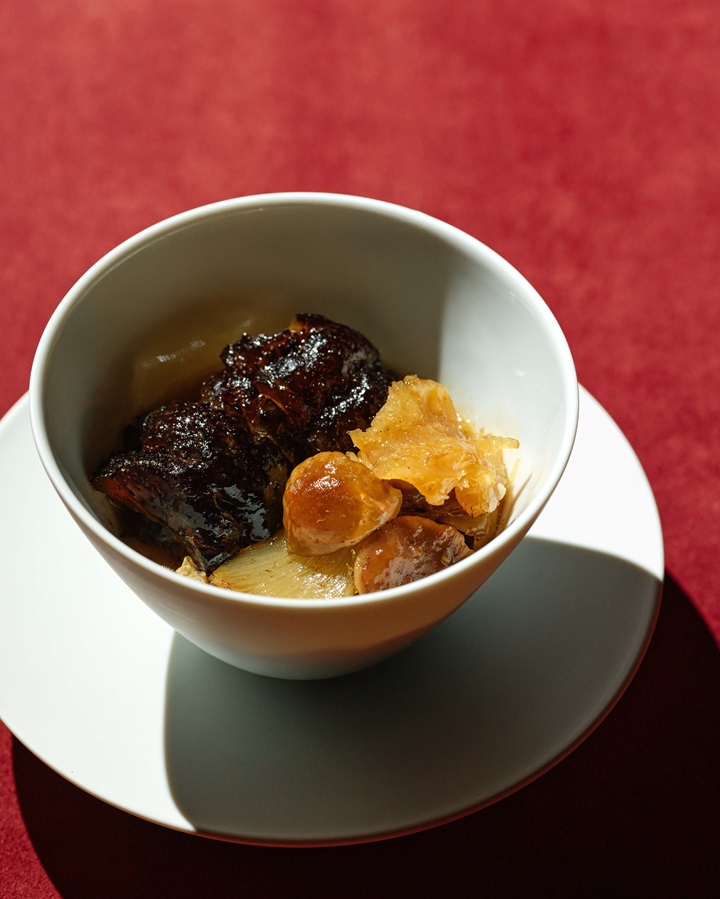
One-MICHELIN-Starred Circum- in Taipei
In Taiwan, Chef Leo Lo of Circum- has taken a fresh approach to Buddha Jumps Over the Wall. “The art of making Fuzhou-style Buddha Jumps Over the Wall is recognized as an intangible cultural heritage and has long been regarded as the ‘king of banquets,’” he explains. “I wanted to reinterpret the essence of its rare, dried ingredients through contemporary culinary techniques.”
Lo selects sea cucumber, shiitake mushrooms and chestnuts, building the dish on a rich stock made from old hen, pork bones and pig trotters, simmered for eight hours. Thirty liters of this stock are reduced to five, creating a thick, aromatic sauce that fully coats each ingredient. The sauced sea cucumber, scallops and other ingredients are then served over steamed egg, where the egg’s fragrance and silky texture unite the deep, layered flavors of the dried seafood.
Lo believes that this method preserves the traditional spirit of Buddha Jumps Over the Wall — “separately prepared, each ingredient distinct” — while accentuating the character of the dried ingredients themselves, giving this historic classic a beautifully balanced, modern reinterpretation.
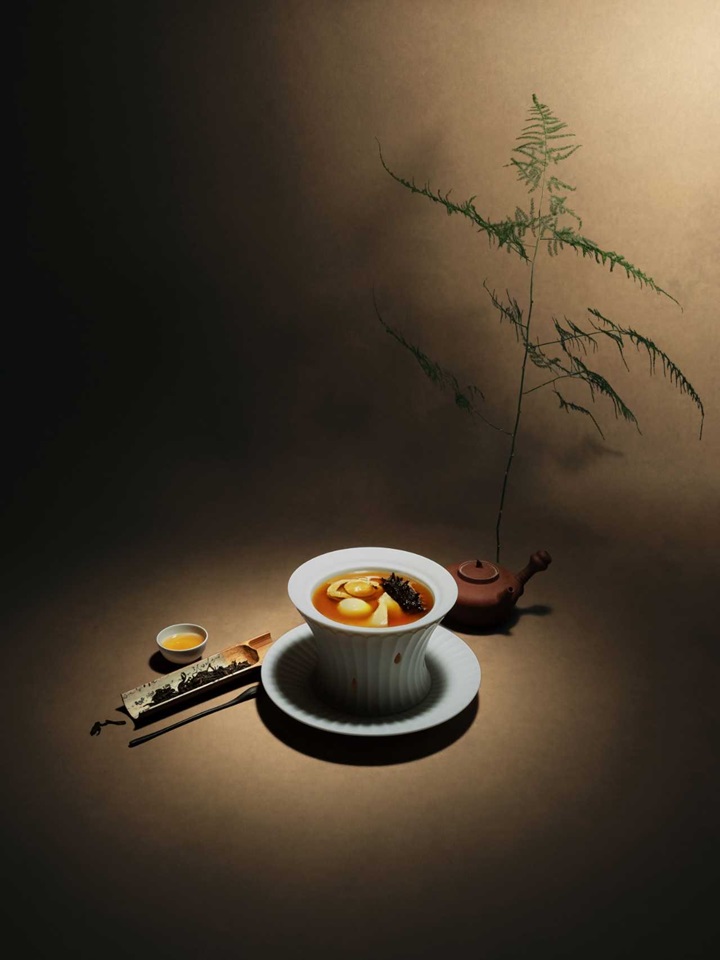
One-MICHELIN-Starred Meet the Bund in Shanghai
Compared with other restaurants’ inventive interpretations, Meet the Bund (Zhongshan Dong Er Road) elevates Buddha Jumps Over the Wall while staying true to traditional Fujian style. Preparing the ingredients takes an entire week: first, old hen and aged duck, rich in flavor and collagen, are simmered into a clear, aromatic stock, while all the dried ingredients are carefully soaked and prepped. In the jar, pig trotters and shiitake mushrooms form the base, followed by gelatinous shark’s tail skin, fish maw, sea cucumber and tendons, with pigeon eggs arranged on top. The jar is then sealed with a lotus leaf and slowly simmered over low heat for eight hours.
RELATED: Wine Pairing for the Lunar New Year: A Guide By Sommeliers of MICHELIN-starred Restaurants
The dish highlights prized seafood, with meat playing a supporting role. After slow cooking, the sea cucumber is tender, the abalone has a soft, molten center, and the pigeon eggs are translucent and delicate. Each ingredient retains its texture while releasing rich collagen into the broth, resulting in a soup that is deeply flavorful, clear and layered with oceanic notes. The subtle aroma of aged Fujian liqueur lingers on the palate, earning this signature Buddha Jumps Over the Wall acclaim both internationally and within the culinary industry.
This sumptuous dish, overflowing with abundance like a treasure bowl, is perfect to share with family during Lunar New Year — a jar of slow-simmered warmth and care.
Sample Buddha Jumps Over the Wall at other MICHELIN Guide–recommended restaurants:
Fujian style – Ming Fu (Taipei), Mountain and Sea House (Taipei), Hokklo (Xiamen), Yanyu (Jiahe Road) (Xiamen)Taiwanese style – Fujin Tree Taiwanese Cuisine & Champagne (Songshan) (Taipei) , Golden Formosa (Taipei), Mipon (Taipei), Shin Yeh Taiwanese Signature (Taipei)
Hong Kong style – Tin Lung Heen (Hong Kong), Man Ho (Admiralty) (Hong Kong), Ya Ge (Taipei)
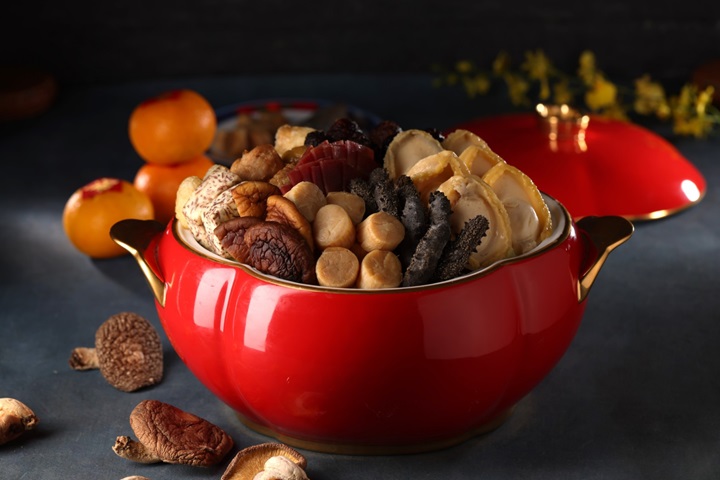
Hero Image: Buddha Jumps Over the Wall from One-MICHELIN-Starred Mountain and Sea House in Taipei