17 December 2025

Share


Don Patrick Baldosano isn’t like other 27-year-olds. “I don’t like music, nor do I enjoy playing any sport,” shared the chef during an interview. “What interests me is searching for new flavors and forgotten ways to cook. My life revolves around food.”
This dedication to anything related to food and culture is the foundation that set up Baldosano to be the recipient of the Young Chef Award of the MICHELIN Guide Manila and Environs & Cebu 2026, presented by Visa. Linamnam, his modest 10-seater restaurant fashioned like a traditional Filipino home, the bahay kubo, was among the eight spots to receive a coveted Star when the MICHELIN Guide was launched in the Philippines last October 2025.
“I think our chef community [in the Philippines] is very healthy and supportive. There is always a feeling of respect and camaraderie with everyone’s work.” Baldosano's laser-sharp focus in the kitchen is complemented by this refreshing take on an industry often touted as cutthroat. “I’m definitely honored to receive the Young Chef Award because it puts our work in the spotlight.”
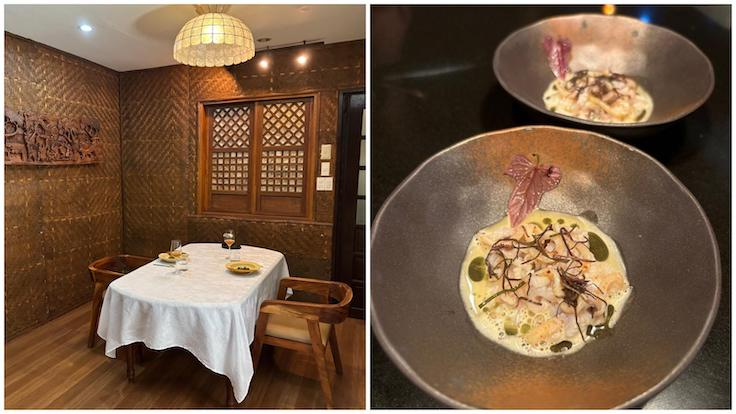
“Linamnam” is a Filipino word that does not have a direct English translation. At the most basic level, it pertains to something delicious. It is a sensory dimension reserved for food full of flavor and depth. The Japanese have umami, or an enhanced level of taste commonly attributed to savory food. Linamnam goes even further than savoring — it brings satisfaction to the soul. Simply, something ma-linamnam is anything that hits home.
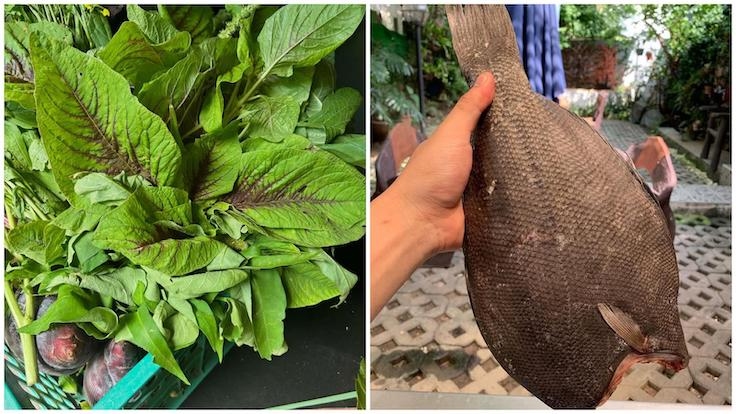
Baldosano grew up knowing what good food tasted like because his parents would prepare it at home. Something as simple as daing (dried fish) and rice, served with laswa, a boiled vegetable soup made with leafy greens they grew in their garden, trained his palate to pick what is fresh and in season.
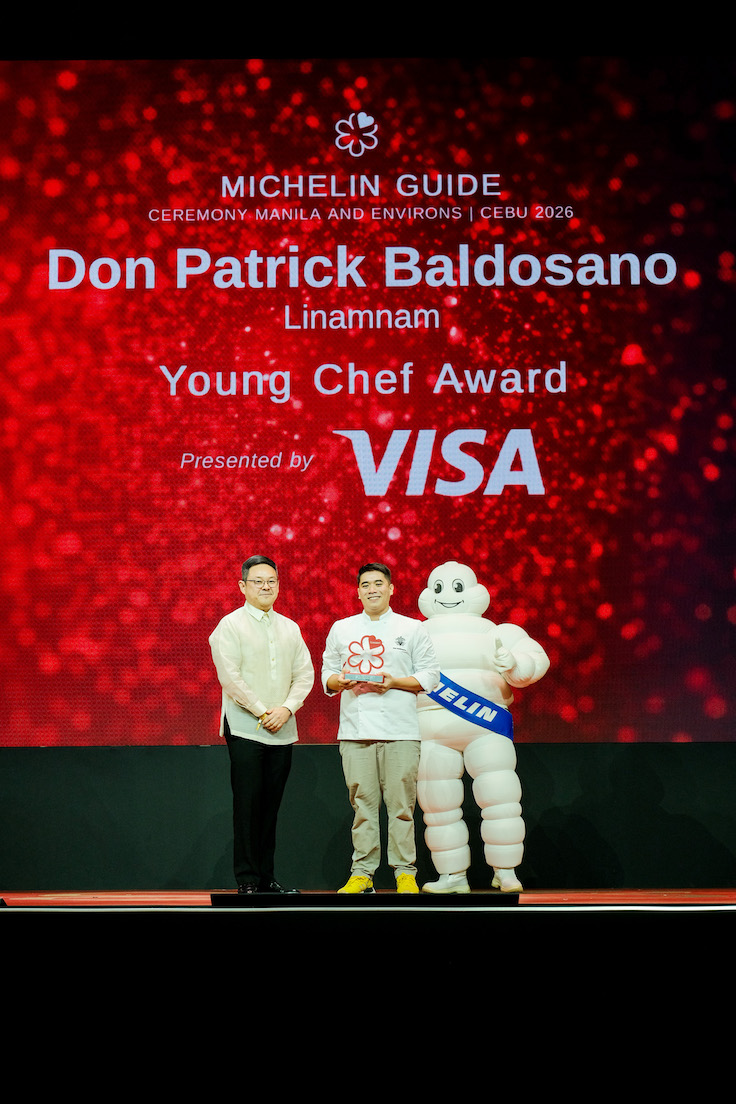
Visa’s support for the Young Chef Award reflects a shared belief in the power of craft and culture to shape how people experience the world. As a partner of the first MICHELIN Guide in the Philippines, Visa helps shine a light on the country’s rising culinary voices — chefs like Baldosano, whose work at Linamnam honors tradition while embracing innovation. By championing moments like these, Visa continues its commitment to connecting people through meaningful experiences in dining, travel and beyond.
(©MICHELIN)
“One thing that struck me as a kid was our use of acidity in our food and how subtle it was compared to other provinces.”
Although Baldosano grew up in Manila, his summers were spent in Capiz, a province in the northeastern part of Panay Island in the Western Visayas. Roxas City, the capital of Capiz, has an 80km coastline of brackish water that flows from the Panay River and the Sibuyan Sea, the small body of water separating Luzon from the Visayas. From these fertile agricultural waters teem an abundance of marine life, from fresh scallops, oysters and diwal (angel wing clams), to mollusks and crustaceans of every kind. Roxas is the Seafood Capital of the Philippines.
“What really stayed with me [from those summers in Capiz] was how we made sinigang, which we always made using leaves of libas (hog plum).” According to the Young Chef awardee, sinigang, the Filipino’s quintessential sour soup often flavored with tamarind, had a more complex broth when soured with leaves, not the fruit, of the native libas tree.
Baldosano joined the Junior MasterChef Pinoy Edition cooking competition when he was 12 years old. Back then, he didn’t yet believe he could pull off cooking delicious dishes, but his experience on the show was the fuel he needed to blaze a trail for Filipino cuisine. From then on, he dedicated his time and attention to food. He obsessed about fermenting and foraging. He played around with the idea of preserving ingredients. Once, he experimented with using soil to preserve root crops. “My bright idea was to add salt to the soil to preserve [the crops] better,” the chef grinned as he recalled the attempt. “Needless to say, it was the best way to make Rock Carrots.”
But without an appetite for risk, our young chef would not have been able to discover one of his favorite pairings of all time: cooking sea urchin with yeasted coconut sauce. “The idea was to make a ginataan dish,” he recounts an experiment involving coconut milk. “Instead of stewing the vegetables, we cooked with roasted yeast instead and paired it with poached sea urchin and squid.” Sample the seafood in Linamnam’s DAGAT (Sea) selection to know what success tastes like.
The Linamnam menu is structured as follows: KAGAT, or bite, for starters; DAGAT, or sea, for shrimp, grouper and urchin; LUPA, or land, for meat; and TAMIS for sweets. Sunog na Kanin, or Burnt Rice, is the only dish that the restaurant has kept after many alterations in the Linamnam menu. Their signature dish is rice cooked in burnt butter and burnt soy sauce. “Rice is something I have focused on for years. Our main course, just being rice, is a culmination of all those years,” Baldosano affirmed.
“One key aspect that we look at is whether an ingredient is really Filipino. Does it serve a purpose in Filipino cuisine? If yes, then more often than not, we use it.”
Aside from determining the origin of a fruit, flower, herb or vegetable, Baldosano also considers seasonality. If an ingredient is at its peak flavor and most abundant during a season, it must absolutely be showcased then.
Foraging for wild produce is another leg upon which Linamnam’s bahay kubo stands. Throughout the years, the chef and his team have cherished cooking with pepinitos, a tiny creeping cucumber with a watermelon-like flesh often found along riverbanks and streams, and lupo, an edible, earthy green with a bitter taste similar to ampalaya. Lupo grows in abundance, usually bursting out of roadsides and dismissed as nothing but a weed.
Why go to these lengths for a Filipino restaurant? The young chef shares that he wasn’t always so ambitiously patriotic.
“My desire to explore our own cuisine stemmed from a time when I actually started hating Filipino food. When I began cooking, all I wanted to cook was French and Italian food, as I thought those two cuisines were the pinnacle of mine.” A conversation with a friend challenged his mind. “When I told him that I wanted to have 3 MICHELIN Stars one day, he asked me if any chef has earned a star without actually knowing their own culture.”
That pivotal moment was the redirection he needed. “From there, I felt bad and started to deeply know more about my own land and its unsung dishes and ingredients from different provinces.”

Linamnam is the personification of Baldosano's homecoming. The bittersweet result is food that is both experimental and nostalgic, like a long overdue return to one’s province.
“The idea behind the bahay kubo setting is to make you feel like you’re in the province while you’re actually in the metro,” he described. “Our team has focused on making guests feel like they were dining in my home. It was about the refinement of the little things so guests can feel like they were catered to as if they were in a fine dining establishment, but at the same time also feel the warmth of Pinoy hospitality.”
An edible ode to being Filipino.
Even after receiving his first MICHELIN Star, Baldosano does not feel the need to scale Linamnam. “I want to be able to keep the soul of the place and continue sharing our message.” To celebrate his first MICHELIN Star and Young Chef Award presented by Visa, Baldosano wants to spend an endless, quiet day on the beach with pizza and liempo (grilled pork), while sipping natural wine in plastic cups.
“For me, a good life is just enjoying the pleasures of traveling for good food and wine.”
Simple yet deep, just like the Filipino notion of savoring something until the soul is full. That is linamnam.
Header image is from Linamnam.